Luma Dream Machine vs Veo
Luma Dream Machine and Veo are both video AI tools, tracked here on price, platforms, integrations, and capabilities. Every figure below is read from the vendor's own pages and dated. No score and no winner: the facts do the picking.

Luma Dream Machine
Creative agents that plan, generate and refine campaign assets

Luma Dream Machine is now presented as a creative agents platform rather than a single video generator. Agents plan, generate, iterate and refine, keeping shared context across every stage of a project, and teams and agents work in parallel in the same workspace. Individual plans start at $30 a month for 10,000 credits.

Veo
Generative video model producing high-fidelity video with native audio
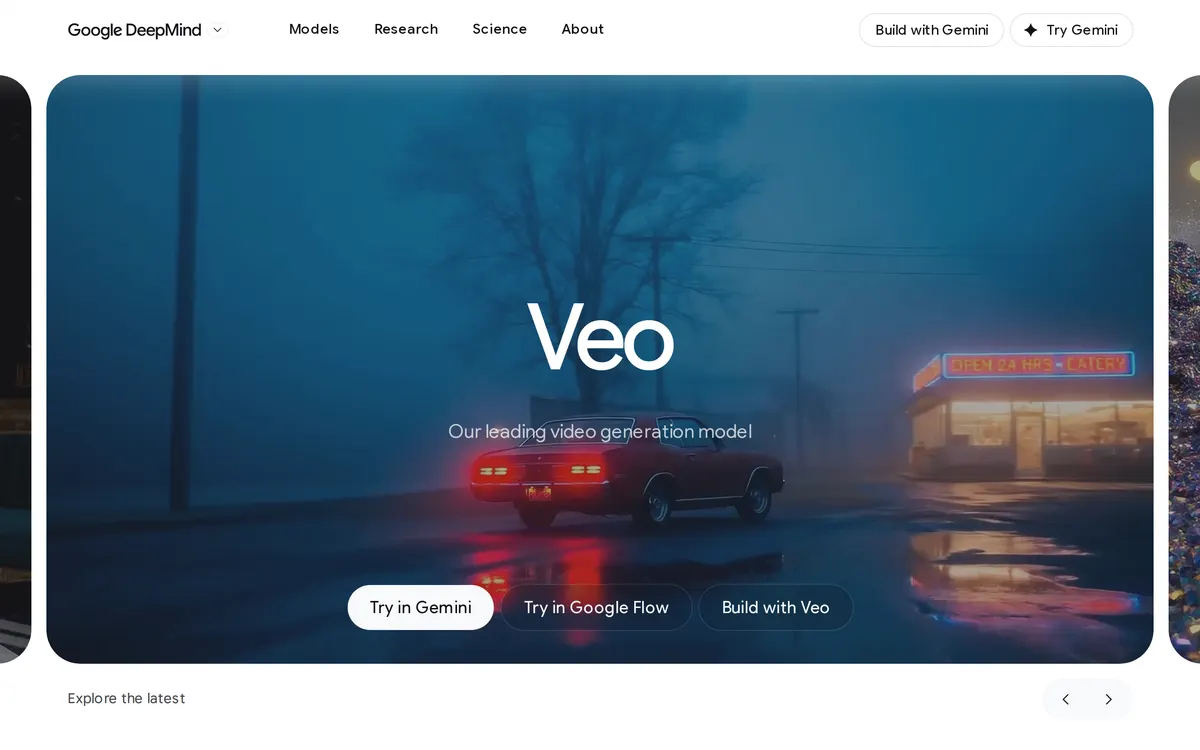
Veo is Google DeepMind's generative video model built for high-fidelity video creation and realistic physics simulation. Iterations such as Veo 3 and Veo 3.1 generate native audio, including dialogue, sound effects, and ambient noise alongside video output. It is accessible through interfaces like Gemini, Google Flow, and the Gemini API.
At a glance
Capability tags are factual labels we assign when a tool is added; they describe what a tool does, not how well it does it.
Checked against the vendors. Written from each vendor's own site and last re-checked there: Luma Dream Machine on September 3, 2026 · Veo on August 31, 2026. Vendors change pricing and features without notice, so confirm anything that decides your purchase on the vendor's page.
Also in video
A tool we have an affiliate relationship with. It is not part of the comparison above and we are not calling it the better pick.

- Turning product documentation into feature walkthroughs
- Creating multi-language video localization and translation
- Automating social media video content and product launches
Key features
Luma Dream Machine
- Creative agents embedded in the workflow
- Shared context across formats and workflows
- Luma Skills, turning repeated workflows into reusable skills
- Team workspaces with shared credits and usage management
- Export for production as high-quality EXR files
Veo
- Native audio generation including dialogue, sound effects, and ambient background noise
- Prompt adherence supporting cinematic parameter notation and camera motion controls
- Real-world physics simulation for realistic video rendering
- Support for creating extended video sequences
What each one does well
Luma Dream Machine
- ✓ Running a multi-asset campaign from one shared context
- ✓ Producing product visuals in several formats and angles
- ✓ Turning a repeated creative workflow into a reusable skill
Veo
- ✓ Generating realistic video scenes with synchronized native audio
- ✓ Cinematic video creation with detailed camera motion controls
- ✓ Programmatic text-to-video development via the Gemini API
People also ask
What is the difference between Luma Dream Machine and Veo?
Both are tracked for video-generation, text-to-video, ai-generation. Of the capabilities they do not share, only Veo is tracked for developer-api, sound-effects.
How much do Luma Dream Machine and Veo cost?
Luma Dream Machine: from $30/mo. Veo: paid.
Answers are generated from the tracked plans and capability tags shown above, so they move when the vendors' pages do.
Full fact sheets, FAQs, and discussion links: Luma Dream Machine · Veo · all video tools